

When your website is new, choosing the right hosting can feel confusing. Many people ask the same question:
Should I start with shared hosting, or should I directly buy VPS hosting?
This question is very common among bloggers, freelancers, and small business owners in India.
In this article, I’ll explain shared hosting and VPS hosting in very simple language, compare them honestly, and help you decide which one makes sense for your website right now. If you’re completely new to hosting, you can also read our shared hosting guide for beginners to understand the basics before choosing.
Table of Contents
ToggleWhat Is Shared Hosting?
Shared hosting means your website is placed on a server that is shared with many other websites.
Think of it like living in a rented apartment:
- One building
- Many families
- Shared electricity, water, and maintenance
Because the cost is shared, hosting companies can offer very low prices, sometimes under ₹100 per month.
Shared hosting is best for:
- New blogs
- Small business websites
- Portfolio sites
- WordPress beginners
- Students and freelancers
You can explore HostitBro shared hosting plans starting from ₹62/mo, which are designed specifically for beginners in India.
What Is VPS Hosting?
VPS stands for Virtual Private Server.
In VPS hosting:
- One physical server is divided into multiple virtual servers
- Each website gets dedicated resources
- You get more control and power
Think of VPS like:
- Living in a private flat
- You still share the building, but your space is reserved
VPS hosting is more powerful — but also more expensive and technical. If you’re planning to scale later, you can check our managed cloud hosting plans for more power and flexibility.
Main Difference Between Shared Hosting and VPS Hosting
Shared Hosting
- Cheapest option
- Shared CPU & RAM
- Beginner-friendly
- No technical skills needed
- Limited power
- Best for low traffic
VPS Hosting
- More expensive
- Dedicated CPU & RAM
- Requires basic technical knowledge
- Better performance
- Handles higher traffic
- More control
Both are useful — but for different stages of your website journey.
Shared Hosting vs VPS Hosting: Feature-by-Feature Comparison
Which Hosting Is Cheaper in India?
| Feature | Shared Hosting | VPS Hosting |
|---|---|---|
| Price | Very low (₹69–₹399/month) | Higher (₹599–₹2,000+/month) |
| Server Resources | Shared | Dedicated |
| Ease of Use | Very easy | Moderate |
| Performance | Good for small sites | Better for growing sites |
| Traffic Handling | Limited | High |
| Security | Basic | Advanced |
| Control | Limited | High |
| Technical Skills Needed | No | Yes |
| Best For | Beginners | Growing websites |
There is no doubt here.
Shared hosting is much cheaper.
For example:
- Shared hosting can start from ₹69/month
- VPS hosting usually starts from ₹599/month
For someone starting a website, paying 8–10 times more doesn’t always make sense.
How Does Speed Actually Differ Between Shared and VPS Hosting?
Speed is where most people notice the real difference between shared and VPS hosting — but the gap is smaller than you think for new websites.
On shared hosting, you share server CPU and RAM with other websites on the same server. On a well-managed server like HostitBro’s, this works fine for small to medium websites. The issue only appears when your site grows or when other websites on the same server experience traffic spikes — this is called the “noisy neighbour” effect.
Here’s what real-world speed looks like for Indian websites:
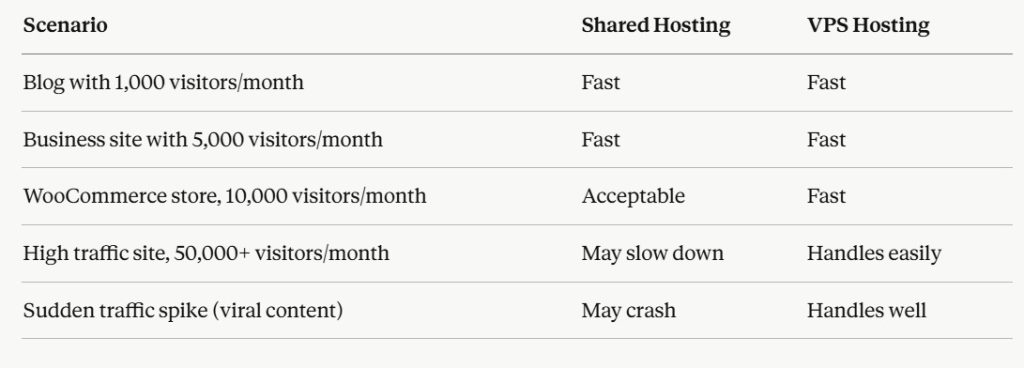
The honest truth is that for 90% of Indian websites — blogs, small business sites, portfolios, service pages — shared hosting with NVMe SSD is fast enough. You will not notice a meaningful speed difference until your site is genuinely large.
What actually makes shared hosting slow is not the hosting type — it’s bad plugins, unoptimized images, and no caching. Fix those first before assuming you need VPS.
Both shared and VPS hosting can be secure — the difference is in how much control you have over that security.
Security: What Is the Real Difference?
On shared hosting:
The hosting provider manages all server-level security for you. This includes firewalls, malware scanning, software updates, and account isolation. You don’t need to configure any of this yourself. At HostitBro, each shared hosting account is isolated from others on the same server — meaning if one website gets compromised, yours is not affected.
Your security responsibilities on shared hosting are simple:
- Keep WordPress and plugins updated
- Use strong passwords
- Don’t install pirated themes or plugins
- Enable free SSL (one click in cPanel)
On VPS hosting:
You get more control, but more responsibility. On an unmanaged VPS, you are responsible for configuring the firewall, installing security patches, setting up fail2ban, monitoring logs, and responding to attacks. If you don’t have Linux server knowledge, an unmanaged VPS can actually be less secure than shared hosting because it’s left misconfigured.
Managed VPS solves this — the provider handles server security for you — but it costs significantly more.
How to Migrate from Shared Hosting to VPS When You Are Ready?
Knowing when and how to upgrade is just as important as choosing the right hosting to begin with. Here are the clear signs that you have genuinely outgrown shared hosting:
Signs it is time to upgrade:
- Your website takes more than 3 seconds to load even after installing a caching plugin
- You are getting consistent traffic above 20,000 visitors per month
- You are running a WooCommerce store with more than 500 products and regular transactions
- Your hosting provider is warning you about exceeding CPU or RAM limits
- You need to install custom software or run background processes
- You manage 10 or more websites and need isolated environments for each
Signs you do NOT need to upgrade yet:
- Your site is occasionally slow but speeds up after clearing cache
- You had one traffic spike from a viral post
- Someone told you VPS is “better” without explaining why for your specific situation
- Your website gets under 10,000 visitors per month
How the migration works:
Moving from shared hosting to VPS or cloud hosting at HostitBro is straightforward. The general process is:
- Take a full backup of your website from cPanel — files and database
- Set up your new VPS or cloud hosting environment
- Restore your backup on the new server
- Test everything on the new server before changing DNS
- Point your domain’s nameservers to the new server
- Confirm everything is working, then cancel shared hosting
If you are on HostitBro shared hosting and want to upgrade, our support team handles the migration for you. You do not need to do it manually.
When you are ready to explore the next step, check out our managed cloud hosting plans which give you dedicated resources without the complexity of managing a raw VPS yourself.
Is Shared Hosting Enough for Small Websites?
Yes — for most small websites in India, shared hosting is more than enough.
If your website:
- Gets under 10,000 visitors per month
- Has basic pages
- Uses WordPress
- Is a blog or service website
Then shared hosting works perfectly.
Many people upgrade too early and waste money.
If budget is your main concern, you can also explore our detailed comparison of Best Shared Hosting Plans Under ₹100 in India to find affordable options suitable for beginners.
When Does VPS Hosting Become Necessary?
You should consider VPS hosting when:
- Your website becomes slow even after optimization
- You receive high traffic daily
- You run an online store with many products
- You need custom server settings
- You host multiple heavy websites
- You want more security control
Until then, shared hosting is the smarter option.
Shared Hosting Is Best for Beginners (Here’s Why)
Low Risk
Easy to Manage
No Server Management
Quick Setup
Budget-Friendly
VPS Hosting Is Powerful — But Not for Everyone
VPS hosting gives you:
- Dedicated resources
- Root access
- More control
- Better performance
But it also comes with:
- Higher cost
- Technical responsibilities
- Server maintenance
- Security configuration
If you’re not ready for this, VPS can become stressful.
Shared Hosting vs VPS Hosting for WordPress
- Works great for blogs
- Easy installation
- Low cost
- Good for learning
- Better for large sites
- Faster under heavy load
- Requires optimization knowledge
What Do Most Indian Website Owners Choose?
- Start with shared hosting
- Learn and grow
- Upgrade only when required
Best Approach: Start Shared, Upgrade Later
- Start with shared hosting
- Build your website
- Get traffic
- Learn basics
- Upgrade to VPS when needed
Why HostitBro Shared Hosting Is Ideal for Beginners
HostitBro shared hosting is a good option because:
- Plans start at ₹69/month
- NVMe SSD storage
- Free SSL
- cPanel included
- Beginner-friendly setup
- Indian-focused hosting
Conclusion- Which One Should You Choose Right Now?
Here is the honest answer based on where most Indian website owners actually are:
If you are starting your first website, running a blog, building a business portfolio, or launching a small WooCommerce store — choose shared hosting. It is affordable, beginner-friendly, and more than capable of handling your website for the first one to two years of growth. Starting at ₹62/mo with HostitBro’s shared hosting, you get NVMe SSD storage, free SSL, cPanel access, and India-based servers without overpaying for resources you do not need yet.
If you are running a high-traffic website, an established ecommerce store, or need custom server configurations — VPS or cloud hosting is the right move. But get there when your site demands it, not before.
The most common and expensive mistake Indian website owners make is paying for VPS hosting when their site gets 2,000 visitors a month. That money is better spent on content, design, or marketing.
Start with shared hosting, build your website, grow your traffic, and upgrade only when the numbers tell you to. That is the practical approach that works for most Indian websites.
If you are still deciding between hosting types, our complete shared hosting guide for beginners walks you through everything you need to know before making a decision.